

“The Year of Saint Francis must not become yet another chapter rich in special spiritual effects, but a silent passage from enthusiasm to deep maturity, from spectacular celebration to imitation in daily life.”
– Pope Leo XIV
The special Jubilee Year of Saint Francis proclaimed by Pope Leo XIV will take place from 10 January 2026 to 10 January 2027, on the occasion of the eighth centenary of the death of Saint Francis of Assisi. The Apostolic Penitentiary, in accordance with the will of Pope Leo XIV, has issued a Decree granting the faithful the plenary indulgence during the Year of Saint Francis, celebrated on the occasion of the 800th anniversary of the death of the Saint of Assisi. The life of the Poor Man of Assisi shows that God’s mercy works in history also through people who have opened their hearts to His action.
Who is St. Francis of Assisi?
Early Life
St. Francis was born in 1181 in Assisi, Italy. Francis’ parents were both wealthy individuals, his father was a wealthy cloth merchant who owned farmland all around Assisi and his mother was a beautiful Frenchwoman. Throughout his youth Francis lived a life away from the Church, he was very spoiled and often indulged himself with food, wine and grand celebrations. By the age of 14 Francis was known around Assisi as the boy who had dropped out of school to party and break city curfew.
In his privileged upbringing, Francis learned the skills of a warrior: archery, wrestling, and horsemanship. He never wanted to follow his father’s footsteps and become a merchant often dreaming of being a future knight and war hero. Francis’ fantasy soon came true in 1200 when a war broke out between Assisi and Perugia and Francis would take his place with the Assisi cavalry. Throughout the war Francis saw horrors he had never known before, because of his rich clothes he wore he was taken as prisoner and lived underground for around a year awaiting his Father’s ransom payment. During this period for him Francis began to receive visions from God.
Eventually in 1203 Fancis’ ransom was accepted and he was released from prison except he was a very different man from before. Upon his return, he was dangerously sick in both mind and body.
His Conversion
One day Francis was riding on a horse in the local countryside and encountered a leper. (Lepers were outcasted from society and no one would typically even come close to them or acknowledge their existence as a person). However Francis had a different reaction than most, Francis got off his horse kissed the leper, showing him love! Later on Francis would reflect on this interaction and call the leper as Jesus incognito.
From that moment forward Francis’ life was changed. He began devoting all this time towards Christ, leaving his past riches well in the past.
Fracniss would spend almost all his time going to remote mountain hideaways and old chores in Assisi praying for God, looking for answers in his life. He also spent his free time assisting nurse lepers and
caring for the sick. One day during his prayer he was praying before an old Byzantine crucifix and Fracnis heard the voice of Christ, telling him to rebuild the Christian Church and take a vow of extreme poverty for Him. Francis listened immediately and began preaching all of Assisi the Good News of Christ, eventually 12 others followed him (this is no condense to the 12 apostles of Christ).
Devotion to Christ
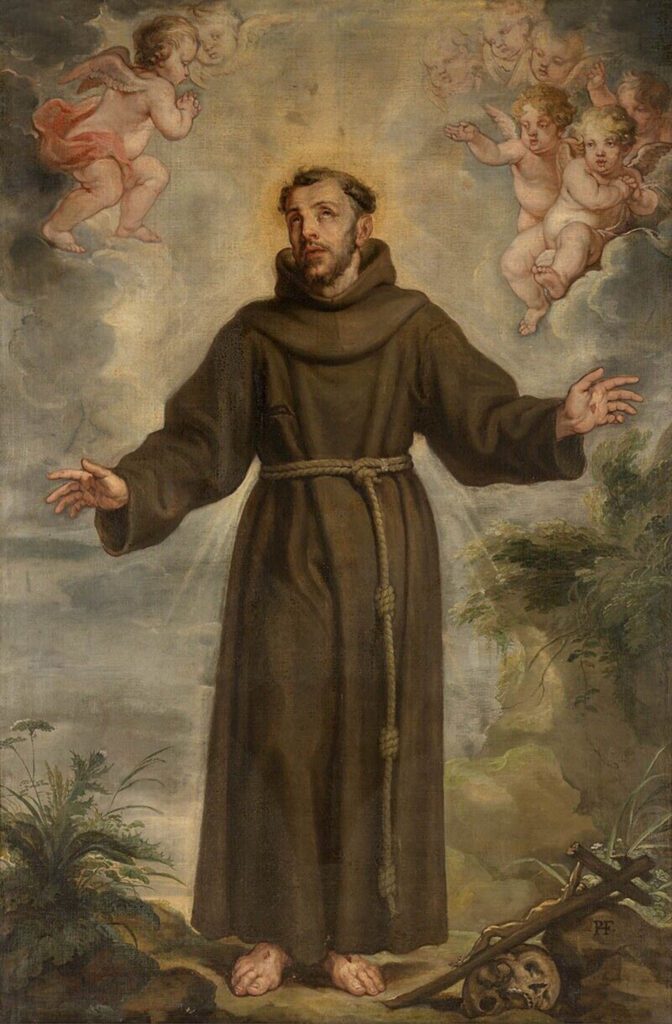
Francis knew that he needed to raise money in order to physically rebuild Chirst’s Church, in order to do so Francis did something risky, he sold a bolt of cloth from his father’s shop and sold his horse. When his father found out Francis had sold his stuff to build a church he was so mad he took Francis to the Bishop to have him punished. The bishop told Francis that he needed to give his father the money back and Frcnias had an extraordinary reaction. Francis stripped off all the clothes we wore and returned all his fathers money. Then he proclaimed loudly that he only had one father, God.
Francis’ embrace of Christ-like poverty was a radical notion at the time. The Christian church was tremendously rich, much like the people heading it, which concerned Francis and many others, who felt that the long-held apostolic ideals had eroded. Francis set out on a mission to restore Jesus Christ’s own, original values to the now-decadent church. With his incredible charisma, he drew thousands of followers to him. They listened to Francis’ sermons and joined in his way of life; his followers became known as Franciscan friars.
Continuously pushing himself in the quest for spiritual perfection, Francis was soon preaching in up to five villages per day, teaching a new kind of emotional and personal Christian religion that everyday people could understand. He even went so far as to preach to animals, which garnered criticism from some and earned him the nickname “God’s fool.” But Francis’ message was spread far and wide, and thousands of people were captivated by what they heard.
In 1224 Francis reportedly received a vision that left him with the stigmata of Christ — marks resembling the wounds Jesus Christ suffered when he was crucified, through his hands and the gaping lance wound in his side. This made Francis the first person to receive the holy wounds of the stigmata. They would remain visible for the rest of his life. Because of his earlier work treating lepers, some believe that the wounds were actually symptoms of leprosy.